
by Gugulethu Manana (Art Therapy)
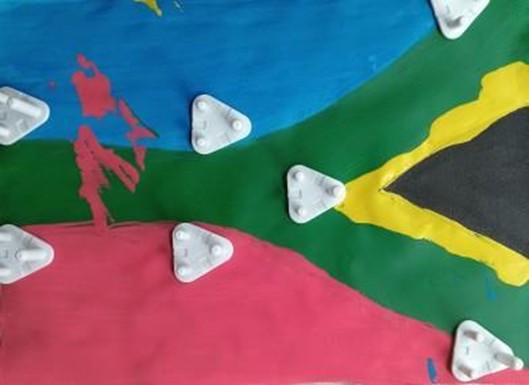
Introduction
As an art therapist (AT) working in a multidisciplinary team (MDT) in the criminal justice system and advocacy, my work is embedded within a broader community-based theory of change. I have come to understand the deep, transformative potential of visual expression in trauma recovery. My work intersects with legal, social, and psychological domains in ways that challenge traditional modes of intervention, and yet, it is precisely within those intersections that my contribution becomes most powerful.
Understanding the landscape I work in
South Africa is a country of profound beauty and pain. I work in Johannesburg North, in a community facing intense poverty, high unemployment, sexual abuse, violence, structural neglect and highly mobile communities. The children and families I meet carry stories marked by intergenerational trauma. The justice system, though critical, is not always trauma-sensitive. My role within this context is not just to offer therapy, but to serve as a bridge between a child’s inner world and the external systems that seek justice on their behalf.
In alignment with the National Strategic Plan on Gender-Based Violence and Femicide (2020–2030), many organisations I work with are mandated to provide holistic, survivor-centred services. Yet implementation remains complex. Within our MDTs, I collaborate with social workers, psychologists, legal officers, medical officers and court support staff. Our shared aim is to offer integrated, compassionate support.
This is implemented through a variety of services including psycho-legal consultations, individual and group therapy sessions, family counselling, court preparation and debriefing. The blend of psychosocial and legal strategies ensures that survivors and their families are not only informed about their rights but also supported emotionally throughout the legal process.
My experience echoes findings from international literature which highlight the importance of art therapists asserting their identity and role within multidisciplinary settings. Caroline Miller (2015) discusses the need for ATs to remain grounded in their theoretical frameworks while negotiating collaborative practices with other health professionals. Similarly, Raymond et al. (2015) emphasise that working together across modalities enhances outcomes for clients and creates a more robust support network when roles are clearly understood and respected.
How I contribute to the MDT
In our team, my contribution is often both visible and subtle; facilitating creative processes/interventions, case material, psychoeducational workshops and nuanced in non-verbal observations and symbolic insights. I offer individual and group art therapy to children, adolescents, and consult with caregivers on various issues. Through painting, drawing, sculpture, and storytelling, my clients begin to process trauma without relying solely on verbal recall.
I also participate in case discussions and court preparation processes. During court preparation, psycho-legal support is provided to clients (often children) to help them understand and emotionally cope with the process of giving testimony in court A client and caregiver can also be granted a protection order based on my process notes and observations: this is a legal order issued by a court to protect a person from harassment, abuse, or threats.
With written and verbal consent, I share what I observe in a child’s image: like themes of fragmentation, fear, or hope that can guide the educational psychologist’s interventions at school or inform the legal team’s timing for testimony. An example of this is of an 11-year-old boy who recreated his home with clay. It had no doors and tall walls. His silent metaphor helped us understand his emotional isolation and gave the team language to advocate for stronger safety measures at home. These moments remind me: art speaks where words fall short.
“art speaks where words fall short.”
Translating the language of art in clinical and legal spaces and challenges in integration
One of the most challenging aspects of my role is having to translate a child’s metaphor into the language of reports and affidavits. Art therapy does not produce linear outcomes. It thrives in ambiguity, symbolism, and emotional resonance. Yet in MDTs, I must often present my findings in language that is clear, practical, and aligned with clinical and legal expectations.
In my organisation, I am fortunate that the role of arts therapy is recognised, valued and supported. It is not seen as less rigorous, or ‘just drawing’. I also facilitate psychoeducation sessions to members, teaching about visual literacy, containment, and why children might choose symbols over speech. The aim is to foster a shared language rooted in respect for each modality. This aligns with the arguments by Powell and Hohenhaus (2006), who stress that effective MDT function relies heavily on strong communication and the ability to integrate multiple perspectives without losing disciplinary identity. Slater, Wong, and Newman (2025) add that arts-based approaches in interprofessional education can foster empathy, relational learning, and deeper collaboration which is key to sustaining effective MDT practices.
ATs must advocate for their approach by demonstrating how symbolism, containment, and aesthetic distance allow clients to process trauma safely. In this regard, the images below are from my own internal process reflecting on how fire changes objects and the different perspectives of interpretation of trauma.



Supervision and Personal Containment
My work is deeply rewarding but emotionally intense. I see pain, shame, resilience, and courage every day. To hold these stories with integrity, regular supervision helps to keep me grounded, both in my work and my own emotional well-being. This is a crucial part of sustainable and ethical MDT work.
This dual focus ensures that therapists remain grounded and can offer regulated, attuned, and developmentally appropriate care to our young clients.
Lis-Ron, Gavron, and Bat Or (2025) highlight the role of supervision in reinforcing therapist identity and reflective practice in complex spaces. Supervision plays a crucial role in sustaining ethical, reflective, and responsive art therapy practice, particularly in the emotionally complex context of multidisciplinary teams.
Staying rooted in the art, our modality
It is easy to lose sight of the core of art therapy when surrounded by legal urgency or clinical protocols. But I maintain rooted in the principles of the modality. I use materials that are culturally relevant, developmentally appropriate, and chosen by the child. I maintain a non-directive approach, especially at the beginning, to rebuild a sense of agency that trauma has taken away.
Drawing on Knash’s (2024) Expressive Therapies Continuum and Perry’s (2006) Neurosequential Model, I stay rooted by matching materials to clients’ needs like clay for sensory grounding in dysregulated children, symbolic drawing for adolescents’ layered experiences and by resting through reflective art, improvisation, and child therapy supervision for clinical guidance and debriefing.
Art therapy is grounded in process, relationship, and symbolic meaning. These principles are not obstacles to MDT work; they are essential contributions. They help teams slow down, listen differently, and understand trauma beyond the verbal.
Advocating for art therapy in MDTs
Being part of an MDT means that I am not only a therapist; I am an advocate. I advocate for the child’s experience to be seen, not just reported. I advocate for creative processes to be respected as valid tools for healing and assessment. I advocate for time, safety, and trauma-informed decisions in court processes.
In parallel, our organisation supports accountability efforts by working with police, prosecutors, and social workers. We provide sensitivity training, wellness sessions, and system monitoring to strengthen survivor-centred practices. This ensures that legal systems not only function but heal.
For example, in court cases, a drawing submitted to the team may help reinforce the severity of a situation that had initially seemed “mild” in verbal disclosures. I believe strongly that our sector needs more creative, embodied, and relational approaches.
This advocacy takes many forms: presenting at team meetings, training colleagues, publishing case insights, and even influencing policy. In some cases, art therapy reports have contributed to successful protection orders, court postponements for emotional readiness, or improved understanding of a child’s development.
A Closing Reflection
To be an art therapist in a multidisciplinary team in South Africa is to stand at a powerful intersection between stories that hurt, and healing that is possible. My work is not about fixing; it is about listening differently, holding space bravely, and believing in the stories told in paint, clay, or pencil.
I invite other professionals to widen the lens. When we include the language of art, we make room for deeper truths to emerge and we become a more compassionate, responsive team. MDTs that include ATs become more attuned, more compassionate, and more complete in their approach to healing.
“To be an art therapist in a multidisciplinary team in South Africa is to stand at a powerful intersection between stories that hurt, and healing that is possible.”

GUGULETHU MANANA
Gugulethu Manana (Gugu) is an HPCSA-registered Art Therapist based in Johannesburg. She works within the criminal justice system and advocacy in an legal organisation, offering psychosocial support andsupporting survivors of trauma, gender-based violence, and sexual abuse through art therapy. Her practice combines creative and trauma-informed approaches to foster healing and resilience.
References
Slater, C.E., Wong, L.Y., & Newman, R. (2025). Arts-Based Approaches in Interprofessional Education: A Scoping Review. Journal of Interprofessional Education & Practice.
Perry, B.D., 2006. Applying principles of neurodevelopment to clinical work with maltreated and traumatized children: The neurosequential model of therapeutics.
Lis-Ron, V., Gavron, T., & Bat Or, M. (2025). Experienced Art Therapists’ Perceptions of the EDPP Supervision Model and Its Impact on Their Professional Work and Identity. The Clinical Supervisor, 44(1), 99–123.
Knash, J.A. (2024). Art Therapy as Cumulative Trauma Repair: Expressive Therapies Continuum, Perry’s Neurosequential Model, and Using Art Therapy Techniques to Inform Perception and Imagination. Taylor & Francis.
Department of Women, Youth and Persons with Disabilities. (2020). National Strategic Plan on Gender-Based Violence and Femicide.
Health Professions Council of South Africa (HPCSA). Ethical Guidelines for Good Practice in the Health Care Professions. Booklet 1.
Miller, C. (2015). Strengthening the Arts Therapist Identity in Multidisciplinary Settings. In Arts Therapists in Multidisciplinary Settings: Working Together for Better Outcomes, 23.
Raymond, A., et al. (2015). Arts Therapists in Multidisciplinary Settings: Working Together for Better Outcomes.
Powell, S.M., & Hohenhaus, S.M. (2006). Multidisciplinary Team Training and the Art of Communication. Clinical Pediatric Emergency Medicine, 7(4), 238–240.
LvA (Lawyers against Abuse): www.lva.org.za
Teddy Bear Foundation: www.ttbf.org.za